Book
Loading book details…
Loading…

Loading book details…
Loading…
The Second Edition of The Ceylon Journal
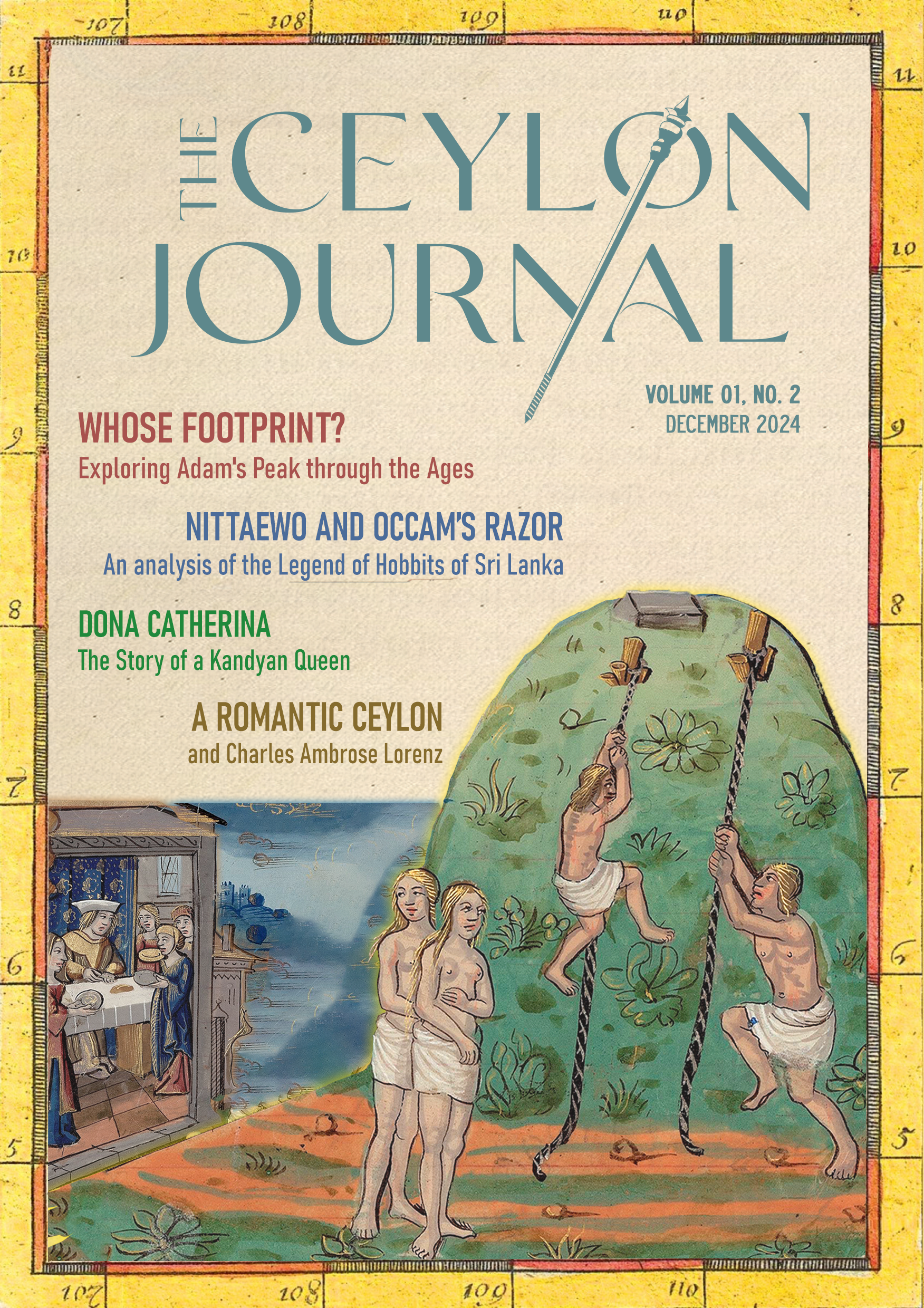
The second issue is dedicated to Fr. S. G. Perera SJ, one of Ceylon's most important historians. He was a Jesuit priest and scholar who spent his life recovering and explaining the island's past, especially the Portuguese and Dutch periods. The issue includes an essay on his Ceylon History for Schools. That textbook shaped how generations of students learned their country's history, and the essay looks at its approach, its influence and where it stands in Sri Lankan historical writing. The issue also carries a full bibliography of Fr. Perera's writings, which gives researchers and general readers a complete record of his scholarship.
The editor writes a portrait of Charles Ambrose Lorenz, one of the leading figures of nineteenth-century Ceylon. Lorenz was a lawyer, legislator, journalist and public intellectual, and his wit and energy left a lasting mark on the island's public life. The essay is illustrated with Lorenz's own caricatures. These show a side of him that is less well known, and they give a lively, firsthand view of the people and society of his time.
Manohara de Silva examines the differing versions of the Kandyan Convention of 1815, the agreement under which the Kandyan Kingdom passed to British rule. The Convention is one of the founding documents of modern Sri Lankan history. Comparing its versions raises questions about what was agreed, how the terms were understood by each party and what the differences meant at the time and afterwards.
Dr. Srilal Fernando writes about the Australian artist Donald Friend, whose time in Ceylon is a notable episode in the island's cultural history. The essay considers his life and work there, his connections with local artistic circles and how the island shaped his art.
The issue revisits the 1982 hijacking of an Alitalia aircraft, a dramatic event with an unusual Sri Lankan connection that drew international attention. The article reconstructs what happened and considers its legal and political consequences.
Dr. Kelum Manamendra-Arachchi contributes a palaeontological study that takes readers far beyond recorded history to the island's prehistoric past. It brings scientific evidence to bear on Sri Lanka's ancient environments and fauna, and it shows the journal's commitment to scholarship across disciplines.
The issue also publishes the keynote address Rohan Pethiyagoda gave at the journal's launch. As a scientist and writer with a long engagement with Sri Lanka's natural and intellectual heritage, he reflects on why studying the island's past matters and on the role a journal like this can play.
The cover reproduces a centuries-old illustration sourced from Burgundy. It is a reminder of how long Europe has been looking at and imagining distant lands, and it suits an issue so concerned with how the past is recorded and passed on.
Copyright © 2026 Heritage Publication