Book
Loading book details…
Loading…
Loading book details…
Loading…
The journal’s 5th issue (Jun 2026): Nevill & Gunaratna—from Jaffna kings to Bawa.
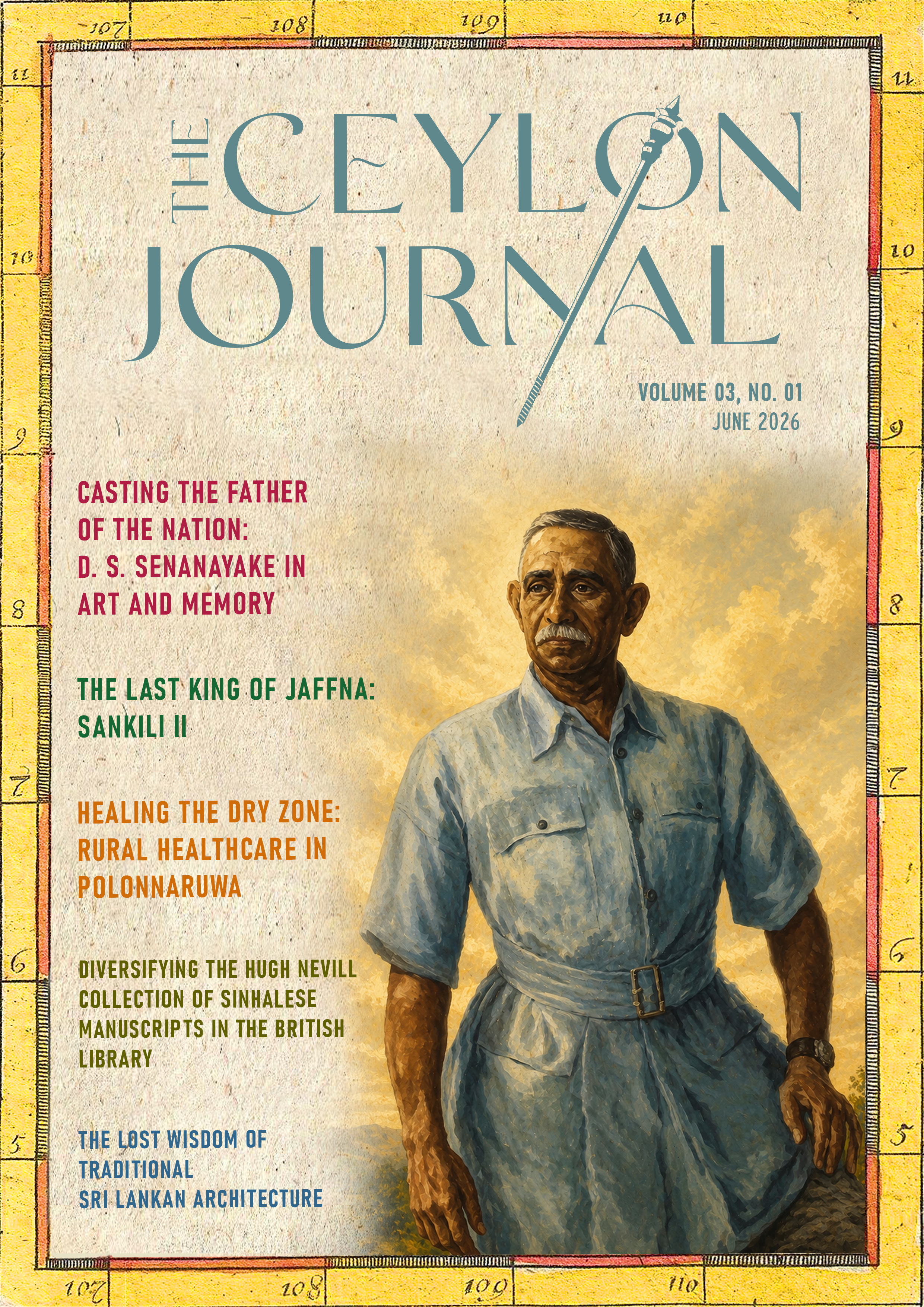
The Ceylon Journal, Volume 3, Number 1 (June 2026) is the journal’s fifth published issue and its most archivally grounded number to date. The entire volume is dedicated to the Hugh Nevill Collection and to the memory of Don Hendrick de Silva Gunaratna — scholar, collector’s advocate and long-time interpreter of documentary heritage for readers in Sri Lanka and abroad.
Contributions range from the last kingship in Jaffna to republic-era nation-building in image and stone; from colonial parks and railway surveys to twentieth-century art and aviation tragedy; from rural clinics and university ethics to a Tamil passion play rooted in northern ritual life. Together they show how scattered records, drawings and oral repertoires can be read as one interconnected island story.
The Hugh Nevill Collection preserves manuscripts, sketches and ethnographic notes gathered across the nineteenth century — material that continues to reshape how historians date literary culture, customary law and regional identity. Essays in this issue return repeatedly to Nevill’s bundles as evidence, as silence, and as an invitation to read against the grain of later nationalist narratives.
The volume also honours Don Hendrick de Silva Gunaratna, whose work linked public libraries, private collectors and classroom readers. The editorial introduction situates each paper against his insistence that serious history must remain legible outside the university seminar — a standard this issue tries to meet with clear notes, consolidated bibliographies and short guides to further reading in national repositories.
A lead study revisits Sankili II, the last ruler of the Jaffna kingdom, tracing the pressures of Portuguese intrusion, intra-regional alliances and the shrinking geography of sovereign rule in the north. The argument is not polemical; it weighs chronicle evidence against administrative correspondence and later folk memory.
A companion essay examines how D. S. Senanayake has been pictured — in statuary, press photography, textbook illustration and private portrait — asking what each medium omits as much as what it celebrates. The piece treats visual culture as political history, not decoration.
Architectural historians contribute a synthetic account of traditional Sri Lankan architecture, from timber halls and ambulatory shrines to courtyard houses and guild workshops. The emphasis falls on proportion, ritual circulation and the social economies that sustained master craftsmen.
Urban historians reconstruct the Old Park of Jaffna as a contested green space: boulevard shade trees, municipal ambition, wartime interruption and post-war replanting debates. Maps and municipal minute books anchor a narrative that many visitors still walk through without knowing its layers.
A biographical sketch restores Maria Wilhelmina Jurriaanse to the documentary history of the island, detailing cataloguing decisions, donor negotiations and the gendered labour of maintaining public memory in the early twentieth century.
Engineering historians follow early railway engineering from survey camps through embankment failures, labour recruitment and timetables that reordered hill-country produce and coastal migration alike. Technical drawings are read alongside strike reports and travellers’ letters.
An art-history pairing treats Charles Freegrove Winzer and Esme Wickremasinghe as witnesses to shifting light, labour and leisure — plantation vistas, harbour sketches and post-independence figure studies — arguing that their albums are archives no less than Nevill’s folios.
A social-medical essay maps rural healthcare in Polonnaruwa across dispensary registers, midwife memoirs and provincial development plans, showing how “modern” public health met seasonal agriculture and ritual calendars in the rice country.
In a sober counterpoint, contributors revisit the Air Lanka Tristar disaster as institutional failure, grief culture and media narrative — with attention to survivor testimony, inquiry transcripts and the long afterlife of aviation policy reform.
An essay on compassion in state universities asks what structural pressures do to teaching communities: crowded halls, contractual lecturers, student protest and the quiet work of mentorship that rarely enters official assessment.
The issue closes its thematic arc with a study of a Tamil passion play from Jaffna — script variants, procession routes, musicians’ guilds and the ethics of staging sacred narrative for mixed audiences in a plural society.
Book reviewers appraise a new study on Geoffrey Bawa, weighing photographic archives against oral histories from draughtsmen and clients. The review situates Bawa within the wider architectural essays in this volume, encouraging readers to compare tropical modernism with the older timber-and-tile grammars treated earlier.
Copyright © 2026 Heritage Publication